The serotonin-gated ion channel 5-HT3R is an important drug target closely associated with depression, chemotherapy-induced nausea and vomiting in cancer patients, and pain.
On September 4 (Beijing time), the team led by Professor Horst Vogel from the Center for Computer-Aided Drug Design at Shenzhen University of Advanced Technology/Faculty of Pharmacy, in collaboration with Professor Mikhail Kudryashev from the Max Planck Institute and Professor Yuan Shuguang from Alphamol Science Ltd., used cryo-EM to uncover a novel self-assembly mechanism of the antidepressant target 5-HT3R. The findings were published as a cover article in the top international journal The EMBO Journal.

Cover of this issue of The EMBO Journal
The team resolved the cryo-EM structure of the target in its native cell membrane environment and unexpectedly discovered that, in addition to the conventional pentameric form, 5-HT3R can also assemble into tetramers. Even more surprisingly, these tetramers exist in two distinct states: symmetric and asymmetric tetramers.
To elucidate the pentamer assembly pathway, the team used computational simulations to illustrate the molecular mechanism of receptor oligomerization from monomers under physiological conditions. Computational simulations and biochemical experiments showed that the pore formed by a single 5-HT3R tetramer is too narrow to allow ion passage for signal transduction. Simulations further revealed that monomer-to-tetramer addition to form a pentamer is energetically more favorable than dimer-to-trimer addition.
“This discovery provides new insights and theoretical guidance for understanding the physiological functions of the 5-HT3R and for designing drugs based on 5-HT3R antagonists.” Corresponding author Horst Vogel stated, “Understanding the functional mechanisms of serotonergic ion channels will bring new hope for treating psychiatric disorders such as depression and schizophrenia.”
Horst Vogel, Mikhail Kudryashev, and Yuan Shuguang are co-corresponding authors. Bianca Introini (PhD student, Max Planck Institute), Cui Wenqiang (2023 PhD graduate, University of Chinese Academy of Sciences), and Xiaofeng Chu (PhD student, Helmholtz Centre for Infection Research, Germany) are co-first authors.
Figure 1. Screenshot of the published article
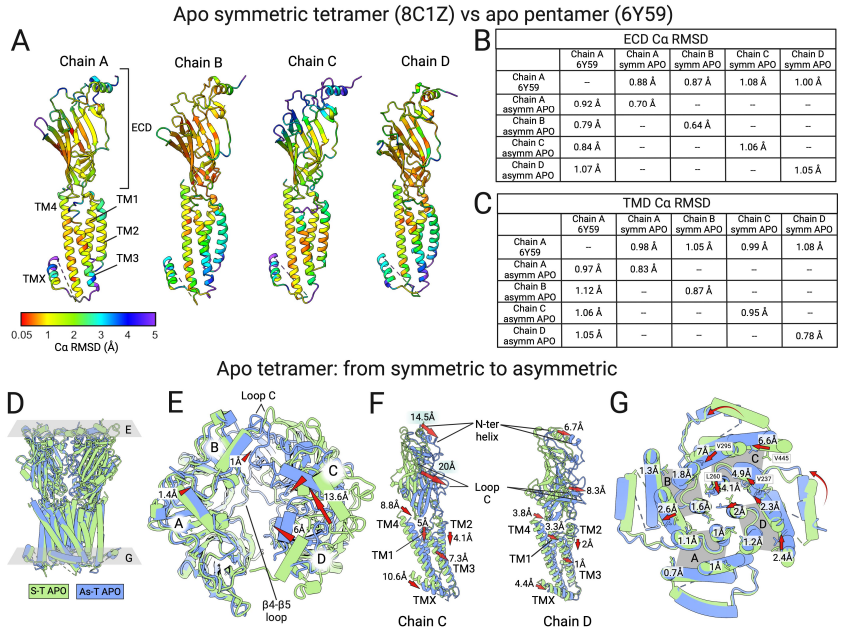
Figure 2. Structural comparison of the 5-HT3A receptor in tetrameric and pentameric forms
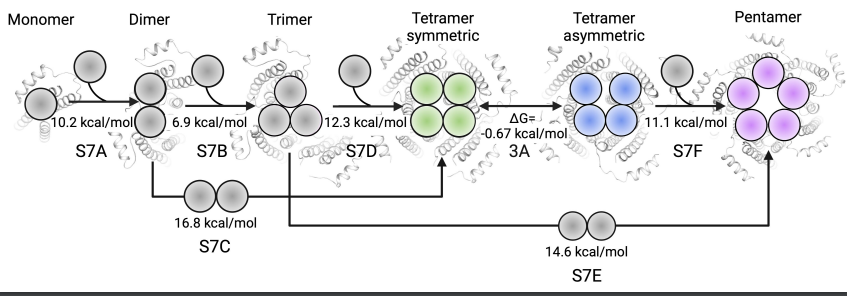
Figure 3. Model of the pentameric assembly pathway
 CN
CN