Last December, the first Dawning Science Festival at Shenzhen University of Advanced Technology (SUAT) featured a collision of "the strongest brains" and "the most passionate expressions," with 26 first-year students delivering academic reports on stage, making Academician Li Guojie of the Chinese Academy of Engineering and former Honorary Dean of SUAT Dawning College smile and say "there are successors!" (Click the blue text to review →First-Year Students Deliver Academic Reports; This SUAT Event Is Full of "Science" Flavor)
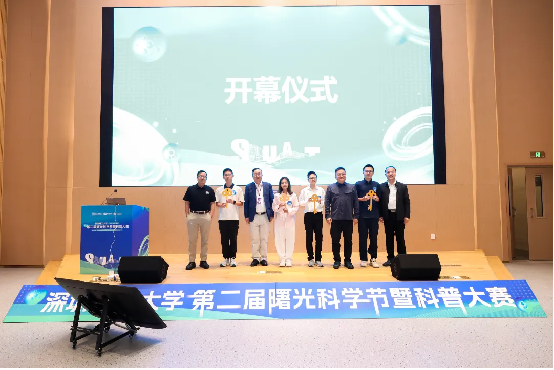
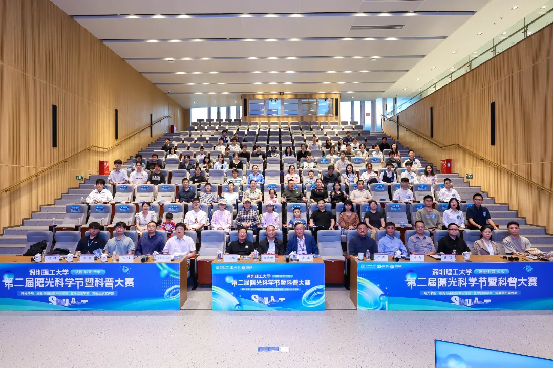
On April 26,the Second Dawning Science Festival and Science Popularization Competition at SUAT arrived as scheduled.17 students delivered academic reports in the format of "5-minute speech + 2-minute Q&A," sharing explorations and discoveries in frontier fields such as artificial intelligence, life sciences, aerospace technology, and neuroscience. Among them, 15 first-year students took the academic stage, showcasing the potential of the post-00s new generation of researchers in scientific innovation and science communication.
First-year student Wang Zhaoxuan shared her experience in depression research with the topic"Application of Mouse Models in Depression Research." In over a semester of research practice, she has joined the laboratory of Chair Professor Han Minghu from the Faculty of Life and Health Sciences, starting to participate in neuroscience research, mainly learning basic neuroscience research techniques, including depression mouse modeling, electrophysiology, and perfusion. "Mouse models have important value in depression research. It has helped discover new targets, such as the relationship between gut microbiota and depression; it has also accelerated drug development, with success rates increasing by 40% after model use. " Wang Zhaoxuan spoke eloquently.
First-year student Hu Zihao delivered a report titled"New Method for Tumor Treatment: Turning Tumors into 'Pork'," addressing the core challenge of tumor cell "immune escape." He highlighted a breakthrough study published in Cell: "This research engineered the Newcastle disease virus (NDV) and introduced porcine α-Gal genes, triggering hyperacute immune rejection after infecting tumor cells, achieving 'disguise recognition—in situ clearance,' opening new paths for systemic oncolytic virus therapy and providing a feasible solution for 'reprogramming tumor recognition using innate immune memory.' " Hu Zihao introduced.
Master's student Cheng Sibo delivered a report titled "Wear the Future: My Evolution with Upper Limb Exoskeletons," analyzing the development process of upper limb exoskeleton systems and sharing how to cleverly match mechanical structures with human dynamics for natural and smooth human-machine collaboration. At the same time, combining his phased research achievements in wearable robot systems, rehabilitation engineering, and industrial aids, he discussed engineering challenges and innovation paths between lightweight design, portability, and functionality. Through real project cases and technical implementation details, he led everyone to think about the application boundaries and development directions of future human-machine fusion technology, fully displaying the style of a rising research star.
In addition, students Li Zhicheng, Cai Xiangyi, Xu Chenxi, Tan Jiayuan, Zeng Zixuan, Jiang Hongyi, Zhang Heng, Liang Jinjie, Liu Yaohao, Xie Meiyi, Yang Jiaqi, Yang Xiaodong, Zeng Haoqian, and Hong Yucong delivered wonderful reports on directions such as cognitive neural mechanisms, artificial intelligence technology breakthroughs, biomedical innovation, and engineering technology.
·
At the event, SUAT Party Secretary Zhu Dijian reviewed the wonderful moments of the first Dawning Science Festival, stating that in this competition,17 students shared the stage with academician-level top scientists for speeches, which is undoubtedly the best practice for learning and inheriting the scientist spirit. He welcomed the community public judges at the event site, pointing out that this is the practice of SUAT's"boundaryless university" concept, stating that the university should closely link and symbiotically win with surrounding communities, enterprises, research institutions, and other elements.
Zhu Dijian believes that science popularization is the cornerstone of innovative development and a key pathway for cultivating future scientific and technological talents. He hopes students take this competition as an opportunity to bravely scale scientific peaks, temper innovative thinking and team spirit in practice, and interpret the fusion of scientist spirit and special zone spirit with wisdom and action.
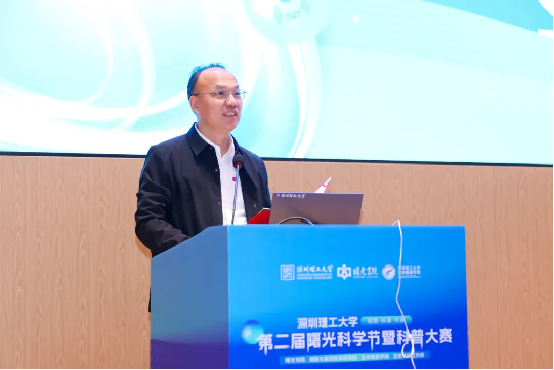
This event also invited
academic experts to share and exchange with students
Kang Le, Dean of the SUAT Institute of Cell and Gene Technology, is an Academician of the Chinese Academy of Sciences and a foreign academician of seven national and international organizations, including the United States National Academy of Sciences. Today, Kang Le invited Yin Ye, CEO of BGI Genomics, to the site to share frontier technology with students. "Dr. Yin Ye is an outstanding scientist and a prolific science popularization writer.Every year, I receive a package of books from him—not the same book, but different science popularization works he wrote. " Kang Le introduced Yin Ye with a smile.
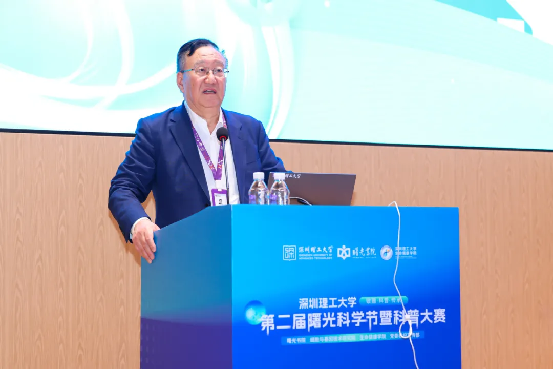
Yin Ye delivered a speech titled "The Singularity Is Approaching, Once Again: Silicon-Based Emergent Intelligence, Carbon-Based Approaching Immortality," exploring the future landscape of artificial intelligence and life sciences. Facing optimistic declarations such as "significantly extending human lifespan within 10 years" and "lifespan possibly extended to 150 years," Yin Ye raised a question with "Sorry, you've oversimplified life." He cited E.O. Wilson's classic assertion, directly pointing to the deep contradiction between technological development and human cognition.
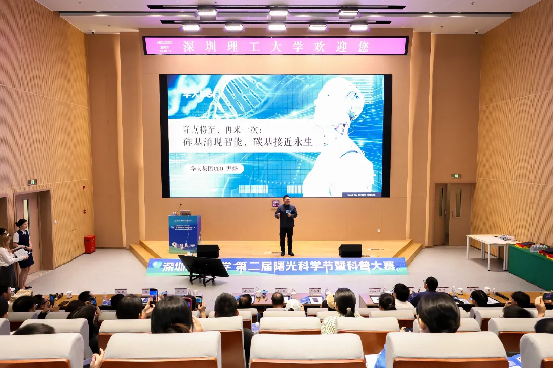
"New directions in science are often driven by new tools rather than new concepts. "Yin Ye pointed out, "Scientific development achieves paradigm evolution through a series of 'scientific revolutions.' Now humanity stands at the threshold of the fifth paradigm—'AI-based self-learning systems exploring high-dimensional dark knowledge in complex systems through traversal computing.' Yin Ye introduced BGI Genomics' innovative explorations leveraging artificial intelligence, showcasing the enormous potential of AI in life sciences.
When discussing scientific research spirit, Yin Ye believes innovation requires courage and determination, and encouraged students to choose careers they love: "One must choose what they like. When others ask me, how long do you work each day? I say, do I work? My work and life seem to be all my interests. "
Finally, Yin Ye emphasized to students, "Humanities without technology may be ignorant, but technology without humanities is certainly dangerous," calling for a sense of awe on the path of exploring science, attention to scientific ethics, and making technology more humane. This highly aligns with SUAT's concept of emphasizing humanities and arts.
Chair Professor Wang Yutian from the Faculty of Life and Health Sciences and Fellow of the Royal Society of Canada delivered a keynote speech titled "My Research Journey." Wang Yutian is from Tai'an, Shandong; his research journey is closely linked to national era development: After high school graduation, he went to the countryside, giving up the opportunity to become a pilot, but this experience strengthened his physique, made him deeply understand farmers' hardships, and added motivation to his later research: "If I could choose again, I would still go to the countryside"; after the resumption of the college entrance examination, he entered Shandong Medical College, seeing patients' suffering, he resolved to study the central nervous system, explore disease mechanisms, and develop drugs. During his master's studies, he overcame the challenges of limited research equipment in China, achieved results, and published papers.
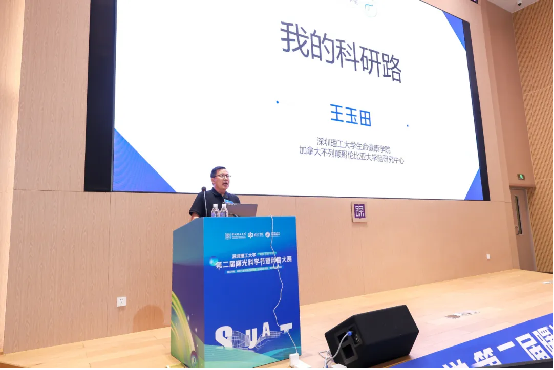
To further his exploration, Wang Yutian went abroad for advanced studies, steadily advancing his academic career with results published in top journals, and eventually becoming a Fellow of the Royal Society of Canada. He is committed to translating research achievements, participating in the establishment of several pharmaceutical companies, with developed drugs making progress in the treatment of stroke and Alzheimer's disease. When discussing the essential qualities of becoming a scientist, Wang Yutian emphasized:"First and foremost is honesty—all research must be honest"; goals should be set reasonably, "otherwise it easily leads to frustration"; one must also have a solid foundation, persist in self-discipline, dare to imagine freely, maintain independence and a challenging spirit, "when reading papers, one should find faults to identify breakthroughs."
Cultivating students involves not only building their academic confidence but also developing their ability to "bring science to the public" through effective communication. Ren Taoshan, mentor at SUAT Dawning College, believes that "the residential college is not only a cultural community but also an academic one; from keynote speeches by academic masters to student-led science popularization practices, it can create a diverse and integrated academic ecosystem."The significance of the Science Festival lies not only in competition but also in allowing young students to understand the mission of scientists through disseminating scientific knowledge: illuminating the unknown with exploration and responding to the times with responsibility. "
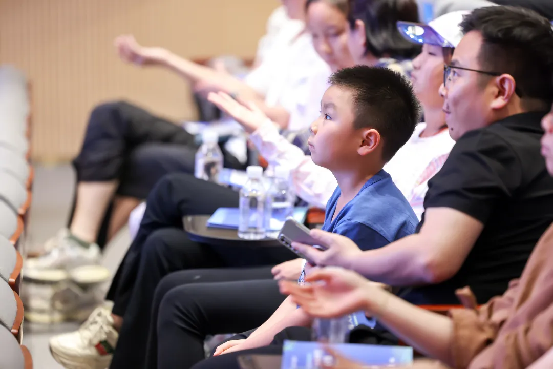
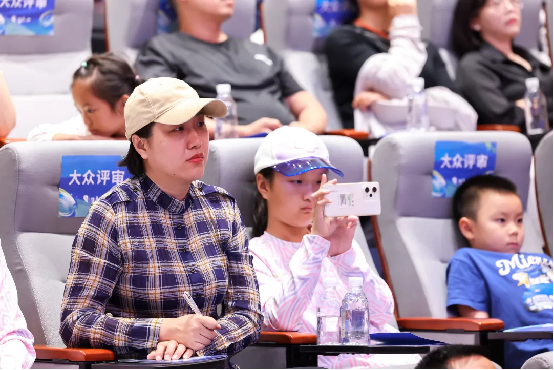
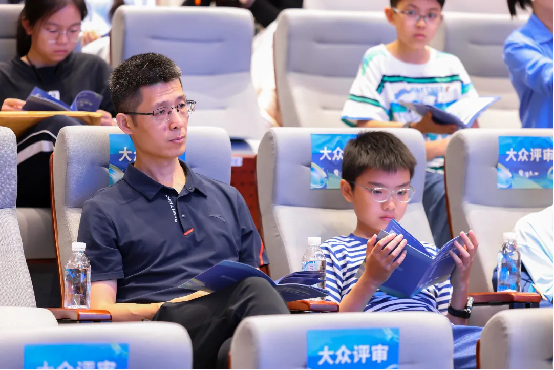
Notably, this competition invited Shenzhen weather anchor Zhou Yu, who has created multiple viral science popularization videos, and the well-known Bilibili science UP main "Lao Qi Hao Hao Qi" to join the judging panel and participate in selecting outstanding works. In addition, there were 25 "extraordinary" public judges, including SUAT faculty and students, nearby community residents, and employees from local enterprises and institutions. The diverse judging composition provided feedback and suggestions for students' reports from different perspectives, further enhancing the event's influence and participation, creating a new paradigm for "science breaking boundaries."
After intense competition and rigorous judging
the winners of this Dawning Science Festival and Science Popularization Competition
are officially announced!
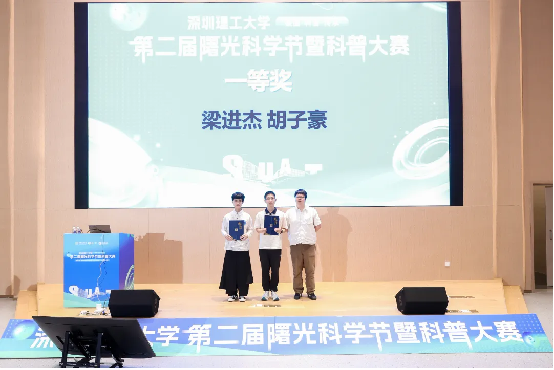
First Prize
Liang Jinjie, Hu Zihao
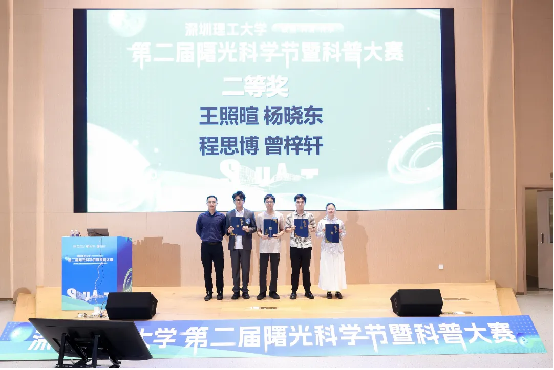
Second Prize
Wang Zhaoxuan, Yang Xiaodong
Cheng Sibo, Zeng Zixuan
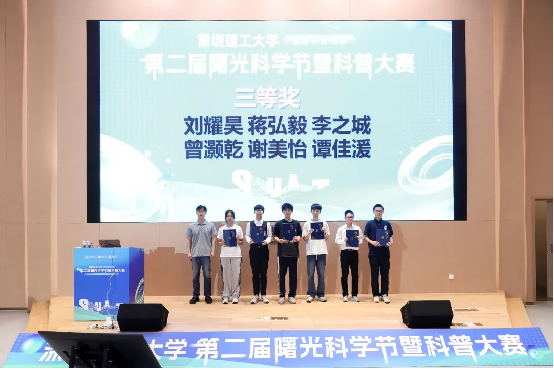
Third Prize
Liu Yaohao, Jiang Hongyi, Li Zhicheng
Zeng Haoqian, Xie Meiyi, Tan Jiayuan
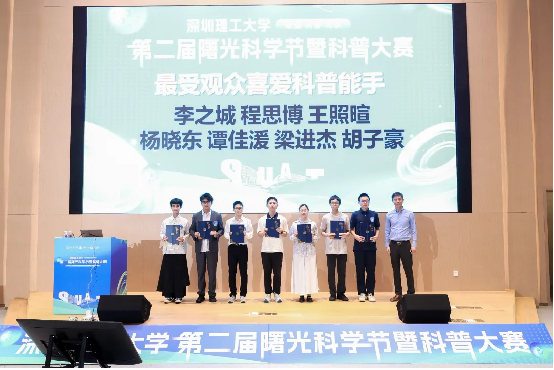
Most Popular Science Communicator Award
Li Zhicheng, Cheng Sibo, Wang Zhaoxuan
Yang Xiaodong, Tan Jiayuan, Liang Jinjie, Hu Zihao

SUAT will hold the Dawning Science Festival every semester, continuously building a growth stage for “academic newcomers”.

From confused freshmen entering campus
to confident "academic spokespersons" sharing frontier achievements
The Dawning Science Festival
not only witnesses their transformation in expression abilities
but also the robust growth of young research forces
In the future
SUAT looks forward to
encountering more "initial lights of research"
witnessing the rise of more new-generation Chinese research forces
 CN
CN