“You have given our daughter a future we never thought possible”. — A Swedish child with a rare genetic disease travels thousands of miles to Guangdong for gene therapy and is reborn
Her bright eyes sparkle and dart around curiously. She can now place both feet flat on the ground and, with her father’s help, take careful steps...
When the distinguished guests at the Academician Forum onCell and Gene Technology Application and Translation — held by Shenzhen University of Advanced Technology during the 26th China Hi-Tech Fair on November 14 — watched this video of two-year-old Alma from Sweden, they broke into heartfelt and spontaneous applause.
Duration 01:02
Just a few months ago, Alma was diagnosed with metachromatic leukodystrophy (MLD). Her left eyelid drooped due to optic nerve damage, her feet turned inward so she could not stand alone and walked unsteadily. Her parents had sought treatment throughout Europe and the United States, but all efforts ended in failure.
In their darkest hour, Alma’s parents discovered hope in Guangdong, China, at the newly founded Shenzhen University of Advanced Technology. They reached out toLian Qizhou from the Faculty of Synthetic Biology at Shenzhen University of Advanced Technology, who has been dedicated to MLD gene therapy research for more than a decade.

“The hopeProfessorLian and his team have given us is priceless.” Alma’s father Juan Macll said with deep gratitude at the forum, “We left Sweden with our critically ill daughter. At that point we had nothing left to lose, but we might win everything.”
1
A Swedish family finds hope for their daughter’s treatment in China
At first, when Alma was just over one year old, she walked a little oddly, but Juan and his wife did not pay much attention. The doctors and nurses they knew also believed there was no cause for concern, thinking Alma was simply developing slowly. However, when Alma was one and a half years old and still could not walk independently, and her language development was significantly delayed, Juan, himself a nurse, realized something was wrong.
He then took Alma for a brain MRI, but several doctors found nothing abnormal. It was not until a pediatric neurologist reviewed the report and told him it might be a genetic disease that subsequent genetic testing confirmed Alma had MLD.

“MLD is a rare hereditary leukodystrophy,” said Lian Qizhou. “It is characterized by biallelic mutations in the ARSA gene, resulting in reduced ARSA enzyme activity and accumulation of sulfatides in the brain, liver, gallbladder, kidneys and other organs.” Over time, MLD causes nervous system damage, leading to motor, behavioral and cognitive regression, severe spasticity, epilepsy and other neurological problems. “The progression from onset to death is extremely short. Patients’ intelligence and mobility visibly decline every three months. In the late stage, inability to swallow leads to starvation, malnutrition, recurrent infections, and lung infections caused by phlegm blockage.”
According to Lian Qizhou, the incidence of MLD is approximately 1/50,000, with about 50,000 surviving patients worldwide and more than 10,000 in China. Statistically, infantile cases under 2 years of age account for more than half (50%–60%) and almost all die before the age of 5. There is no effective treatment after onset, particularly for infantile patients, with a very poor prognosis.

Juan learned that gene therapy was currently the most promising method to save Alma’s life. “However, Swedish hospitals could not provide effective treatment for her. I emailed every MLD-related doctor and expert I could find in Europe and the United States, but all refused without exception because Alma already had symptoms. They only consider treatment for pre-symptomatic children, fearing that post-symptomatic cases progress too quickly and carry too high risk.”
Juan did not give up. In early June this year, he foundprofessorLian Qizhou’s paper on autologous hematopoietic stem cell transplantation and learned that the team had accumulated 10 years of successful experience in saving post-symptomatic MLD patients, proving their approach is long-term safe and effective. “I had to contactprofessorLian—thiswas something I had to do — there was no other choice.”
2
Gene therapy opens the door to treating hereditary diseases
“After receiving Juan’s email and learning about Alma’s condition, I immediately contacted my long-term collaborator Director Jiang Hua,Head of Hematology and Oncology at Guangzhou Women and Children’s Medical Center.” Lian Qizhou recalled. The two teams quickly assessed Alma’s condition via online meetings, evaluating neurological damage in motor function, speech, grip ability, etc., and formulated a preliminary treatment plan.
“Although Alma had already developed symptoms, she was still in the early stage, and we could treat her with gene therapy.” Lian Qizhou said. The U.S. FDA has just approved a similar gene therapy, Libmeldy, for this disease, but only for pre-symptomatic patients, limiting the beneficiary population. “Our next-generation gene therapy can treat post-symptomatic cases, greatly expanding the indications and bringing hope to patients who have already developed symptoms.”
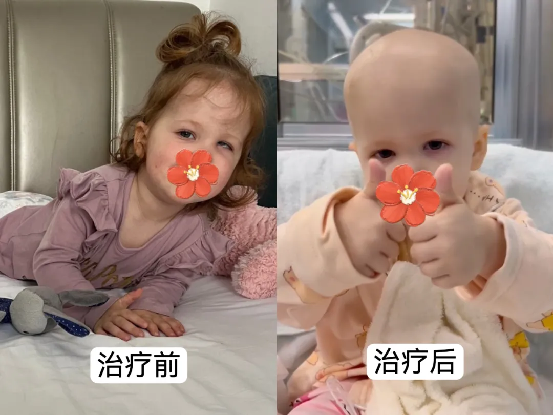
After treatment, optic nerve damage in the left eye was significantly improved
Lian Qizhou explained that autologous hematopoietic stem cell gene therapy was chosen over traditional allogeneic transplantation because the latter has difficulties in donor selection, progressive worsening within six months post-transplant, severe drug side effects, and high rejection risk. In comparison, gene-modified autologous stem cell transplantation does not require long-term immunosuppressive agents and better guarantees reduced infection risk and neurological damage. “Most importantly, Alma cannot wait.”

After treatment, foot inversion was significantly improved
According to Director Jiang Hua, Alma was first admitted on August 30. After autologous hematopoietic stem cell collection, central venous catheterization, and myeloablative conditioning, the team successfully reinfused the gene-corrected autologous stem cells into Alma on October 9. On October 25, Alma was successfully discharged.
“Although Alma has been discharged, long-term follow-up is still required to ensure full recovery,” said Lian Qizhou. In fact, Alma is not the first patient we have treated. “We have previously achieved long-term clinical stabilization in several post-symptomatic juvenile-onset MLD patients, with follow-up exceeding ten years.— that is the paper Juan read. ”
In the past, when facing hereditary diseases including MLD, doctors were essentially helpless and could only provide palliative or symptomatic treatment. The reason gene therapy has become a breakthrough and cutting-edge treatment in modern medicine is thanks to recent advances in synthetic biology, vector design, delivery technology, and gene editing technology.
3
Embracing the future of synthetic biology in Shenzhen
“AsprofessorLian said, synthetic biology is an emerging biotechnology developed on the foundation of systems biology and advanced enabling technologies, empowered by artificial intelligence and automation, enabling it to tackle complex diseases.”Dean Zhang Xian’en of the Faculty of Synthetic Biology said, “We have recently released theSynthetic Biology Roadmap, consisting of four parts: theoretical framework, enabling technologies, innovative applications, and governance principles, with defined development goals and potential technology pathways.”
Currently, China is vigorously developing synthetic biology research, and Shenzhen has built a complete innovation ecosystem chain covering upstream and downstream from original research to industrial development. For example—
Shenzhen has listed synthetic biology as one of the eight future industries in its “20+8 industrial cluster policy, built the world-leading intelligent life system design and manufacturing platform —Shenzhen Synthetic Biology Infrastructure, as well as the Shenzhen Institute of Synthetic Biology, State Key Laboratory of Quantitative Synthetic Biology, National Industrial Innovation Center for Bio-manufacturing (NIICB), Industrial Innovation Center for Engineering Biology and many other research and industry platforms.
In addition, the Faculty of Synthetic Biology at Shenzhen University of Advanced Technology and the Institute of Synthetic Biology (iSynBio) at the Shenzhen Institutes of Advanced Technology, Chinese Academy of Sciencesrepresent one of the world’s largest concentrations of synthetic biology researchers, with distinctive strengths in synthetic biology and biomedicine (especially cell and gene therapy), bio-agriculture, bio-chemical engineering, and bioelectronics.
“In the next step, our team will utilize the Shenzhen Synthetic Biology Infrastructure and AI-enabled synthetic technologies to further optimize gene circuit design, component modification, and gene vector delivery, providing safer, more effective, and controllable gene therapy. ” Lian Qizhou hopes that with continuous development of synthetic biology research, more patients with genetic diseases like Alma will receive better treatment in the future.
 CN
CN