Did you know?
The plants around us are like precisely operated “smart factories.”
The unfolding of every leaf and the elongation of every root follow complex “work instructions.”
Research Advances
On March 6, Professor Qi Linlin from the Faculty of Synthetic Biology at Shenzhen University of Advanced Technology, in collaboration with the team of Jiří Friml at the Institute of Science and Technology Austria (ISTA), unraveled this mystery of the plant kingdom. Their groundbreaking discovery, published inNature, overturns textbook knowledge by confirming that, in addition to the well-known “commander” auxin, plant cells also rely on a crucial “messenger”—cyclic adenosine monophosphate (cAMP)! (Click “Read more” at the end of the article to access the paper directly)
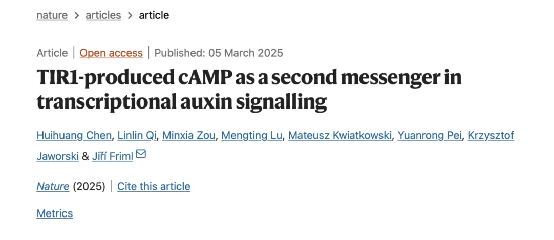
Screenshot of the published article
Imagine the plant growth control system as a busy urban traffic hub.
Auxin acts like a “commander” holding a pass.
Whenever it appears,
it triggers the opening of a series of special pathways.
Over the past two decades, the scientific community has generally believed that this “commander” must operate through a specific mechanism (auxin binding promotes interaction between the TIR1/AFB receptor and co-repressor Aux/IAA; the E3 ubiquitin ligase activity in TIR1 leads to ubiquitination and degradation of Aux/IAA, thereby relieving repression of ARF transcription factors) to allow “vehicles” (downstream gene expression) to proceed.
However, the researchers discovered
a parallel cAMP-dependent signaling pathway.
Even when the canonical Aux/IAA degradation pathway is intact, cAMP can independently activate downstream transcriptional responses.
“The textbook auxin signaling model, which has dominated the field for nearly two decades, posits that Aux/IAA degradation is both necessary and sufficient for downstream transcriptional responses,” explained Qi Linlin. Just like Aux/IAA acting as the “brake” in the plant growth program—removing it should start the engine— “but we found that’s not necessarily the case. Aux/IAA degradation is neither necessary nor sufficient for downstream transcriptional regulation. The adenylate cyclase (AC) activity of TIR1 protein and its product cAMP play an indispensable role in auxin signaling, and we have confirmed the long-standing debate that cAMP is indeed a second messenger in plant cells.” ”
In fact,
during his postdoctoral research in Jiří Friml’s group in 2022, Qi Linlin,as first author, published a paper inNature reporting for the first time that the TIR1/AFB receptor family possesses adenylate cyclase activity, catalyzing ATP to produce cAMP and thereby regulating root growth inhibition and gravitropic responses.
However, the relationship between the AC activity and E3 ubiquitin ligase activity of TIR1/AFB, as well as whether cAMP truly functions as a second messenger in auxin signaling, remained unclear at that time.
In the current study, through a series of experiments, the team found that Aux/IAA plays a dual role: it is a core component of the ubiquitination-degradation pathway and a key switch regulating AC activity. Loss of AC activity in the TIR1/AFB auxin receptor does not affect Aux/IAA protein degradation but blocks auxin-induced transcriptional regulation, indicating that Aux/IAA degradation alone is insufficient to fully mediate auxin transcriptional responses. In other words, simply removing the “brake pad” does not necessarily start the plant growth program.
Furthermore, by inducing expression of an artificially constructed fusion protein to generate cAMP near Aux/IAA-ARF complexes, they bypassed both TIR1/AFB auxin perception and Aux/IAA degradation. Even with stable Aux/IAA repressors present, ARF-mediated transcription was activated, mimicking auxin’s biological effects. This demonstrates that, under these experimental conditions, cAMP alone is sufficient to initiate auxin transcriptional responses and that Aux/IAA degradation is not a necessary condition for auxin transcriptional regulation. In other words, in auxin-mediated plant development, activation of the growth program does not require Aux/IAA degradation — cAMP alone is sufficient.
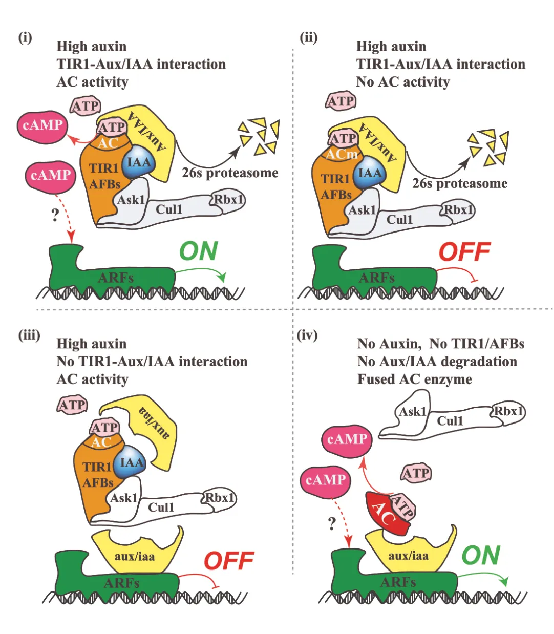
cAMP is a second messenger in the auxin signaling pathway
The study shows that Aux/IAA degradation is neither necessary nor sufficient for downstream transcriptional regulation, and that the AC activity of TIR1 and its product cAMP play an indispensable role in auxin signaling.
This study provides the first genetic evidence confirming cAMP as a second messenger in plant cells, opening new avenues for future research.
Jiří Friml is the corresponding author. PhD student Chen Huihuang from ISTA, Qi Linlin, and Dr. Zou Minxia from ISTA are co-first authors. Professor Mark Estelle (University of California, San Diego, member of the US National Academy of Sciences) and Professor Stefan Kepinski (University of Leeds, UK) provided constructive comments on the manuscript. The project was supported by the European Research Council, the Austrian Science Fund, the General Program of the National Natural Science Foundation of China, ISTA ICP, and an EMBO Postdoctoral Fellowship.
 Profile
Qi Linlin
Professor, Shenzhen University of Advanced Technology
Recipient of a national-level young talent program
Published 10 papers as first or co-first author in journals includingNature (2),Plant Cell, New Phytologist, andPlant Physiology. The research group primarily uses Arabidopsis thaliana as a model to study the role of the second messenger cNMP in auxin and other signaling pathways and aims to apply the resulting knowledge to genetic improvement of crops such as tomato and soybean. The lab currently has openings for research assistant professors/associate professors, postdoctoral researchers, research assistants, etc. Interested candidates are welcome to contact: qilinlin@suat-sz.edu.cn
 CN
CN