Auxin is a key hormone in plant development. Although the critical roles of auxin biosynthesis and polar transport in establishing auxin maxima are well understood, how these processes are regulated and coordinated to generate and maintain localized auxin accumulation remains unclear.
Recently, the team led by Professor Yang Zhenbiao (Director of Institute for Future Agriculture and Chair Professor of Faculty of Synthetic Biology, Shenzhen University of Advanced Technology) published in Nature Communications, elucidating a self-regulating auxin flow mechanism mediated by the auxin transporter PIN2 in Arabidopsis cotyledons. Thisreveals precise control of cell expansion and morphogenesis, offering a fresh perspective on plant organ development.
Using the cotyledon system, where auxin maxima at the tip drive expansion, the team found that a row of elongated margin cells (MCs) at the cotyledon edge accumulate polarly localized PIN2, forming an apex-directed polar auxin transport system. This system is transiently established via self-activation and self-termination mechanisms, powerfully coordinating the interlocking of epidermal pavement cells (PCs).
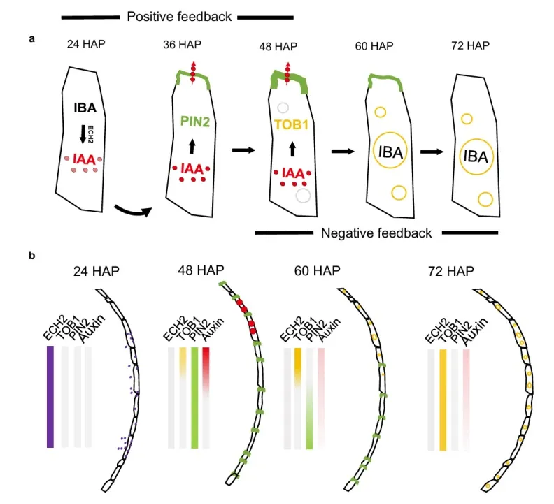
Model of self-organized transient auxin flow at the cotyledon margin
The study further revealed that the auxin precursor indole-3-butyric acid (IBA) is converted to active indole-3-acetic acid (IAA) in margin cells, initiating PIN2 accumulation and polar transport. As auxin levels rise at the tip, a negative feedback loop is triggered: TOB1 (IBA transporter 1) expression sequesters IBA into vacuoles, halting PIN2 accumulation and terminating the dynamic auxin flow.
This discovery not only uncovers a cell-level self-regulatory mechanism for auxin but also provides new insights into signal transduction during plant development. The researchers believe that this mechanism is not limited to leaf development but may also play a role in other critical processes of plant development, such as root elongation and branching.
Professor Yang Zhenbiao (former Professor at the University of California, Riverside) is the corresponding author, and Dr. Patricio Pérez-Henríquez (University of California, Riverside) is the first author. This study was a collaborative effort involving Fujian Agriculture and Forestry University, the University of California, Riverside, and other domestic and international institutions. It was supported by the National Natural Science Foundation of China, Fujian Agriculture and Forestry University, Shenzhen University of Advanced Technology, Shenzhen Institutes of Advanced Technology (SIAT), Chinese Academy of Sciences, the National Center for Complementary and Integrative Health (USA), and the U.S. National Science Foundation.
 CN
CN