https://mp.weixin.qq.com/s/PZ19VcEIFp4sjArZDTb3cw
Nature Communications | “Taming” zinc metal with a lead lattice: Shenzhen University of Advanced Technology achieves 10-fold lifespan extension for energy-storage flow batteries
Aqueous zinc–bromine flow batteries hold great promise for grid-scale energy storage due to their low cost, high safety, and strong storage capacity, yet they suffer from short lifespan and premature failure.
A research team from Shenzhen University of Advanced Technology has solved this challenge. Their findings were published inNature Communications on April 5. (Click “Read more” at the end of the article for paper details) The study was supervised by Academician Cheng Huiming from the Academician Workstation at Shenzhen University of Advanced Technology. Assistant Professor Lian Guojin and Associate Professor Sun Yuanmiao from the Faculty of Materials Science and Energy Engineering are co-corresponding authors. Jointly supervised PhD students Hu Yichan and Min Zhiwen from Shenzhen University of Advanced Technology are co-first authors.
“The short lifespan arises because, during charging and discharging, zinc metal grows uncontrollably into dendritic structures. These ‘metal spikes’ can pierce the separator, causing short circuits and drastically reducing battery life,” explained Liang Guojin. Additionally, hydrogen evolution produces gas bubbles that further degrade efficiency and longevity.
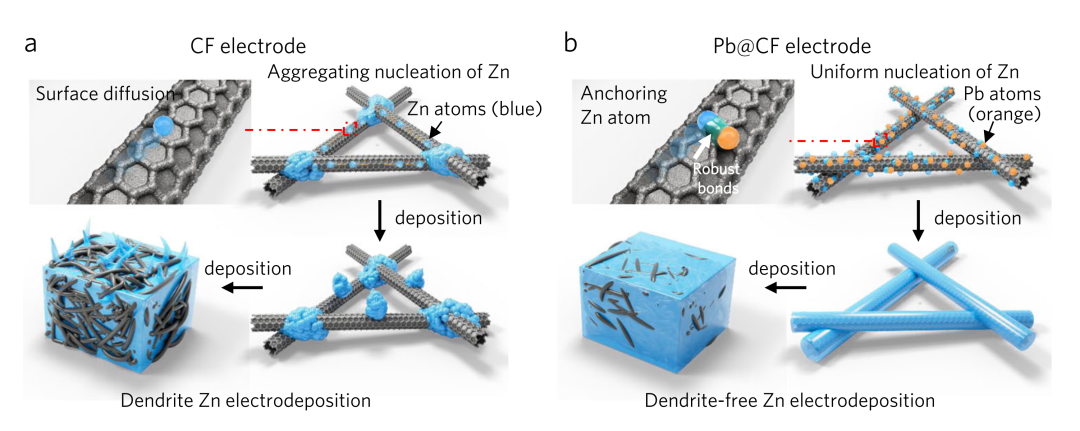
Schematic illustration of zinc nucleation and growth behavior regulated by different electrodes. (a) Conventional carbon felt electrode; (b) Lead nanoparticle-modified carbon felt electrode (gray spheres: carbon atoms; blue spheres: zinc atoms; orange spheres: lead atoms).
Liang Guojin introduced thatthe team developed a highly reversible carbon felt electrode uniformly decorated with lead nanoparticles. These lead nanoparticles act like “traffic signs,” guiding zinc to deposit smoothly and uniformly, preventing dendritic growth. Moreover, the lead-modified electrode exhibits a higher hydrogen evolution overpotential, effectively suppressing hydrogen evolution and bubble formation, thereby enhancing operational stability.
Experiments demonstrated that zinc–bromine flow batteries using this modified electrode achieved dramatically extended lifespan, sustaining over 2300 hours with a cumulative capacity of 23 Ah cm⁻² per unit area and an average energy efficiency exceeding 78%.
Under harsh conditions, the battery delivered stable cycling for over 4000 cycles—approximately a 10-fold improvement over conventional batteries, which typically last only a few hundred cycles. Even at ultrahigh current density/areal capacity (100 mA cm⁻²/100 mAh cm⁻²), the lead-modified electrode effectively suppressed dendrite growth and hydrogen evolution.
“This work provides valuable insights into designing highly reversible zinc anodes for zinc-based flow batteries,” said Liang Guojin. The lead nanoparticle-modified carbon felt electrode offers a cost-effective and efficient solution that significantly enhances zinc anode reversibility, greatly improving the practical viability of zinc–bromine flow batteries for large-scale, low-cost energy storage.
 CN
CN